Christmas Eve Reflections: What I’m Carrying Into the Next Chapter
Contemplating Purpose and Direction
Christmas Eve has a way of slowing time.
The noise fades. The year exhales. And for a brief moment, we’re left with what actually matters… the people we love, the story we’re living, and the questions we can’t ignore anymore.
Today, I find myself both reflective and strategic.
Conquer Discouragement: Unlock Your Unshakable Drive
Conquer discouragement from the moment it arises, because discouragement kills momentum if you let it. We’re here to face it head-on, not tiptoe around it. Time is too valuable to mince words. Our minds suffer from negativity and confirmation biases—put those two together, and you get discouragement, a natural response to unexpected or unsatisfactory outcomes. The higher the stakes, the deeper it can set in.
Making Meaningful Memories: Crowd Out Misery, Find Joy
When it comes to making meaningful memories, it can feel like our lives have their own gravitational pull… just like my dining room table, forever inviting clutter to come piling back. About once a week, I clear off a mountain of random stuff: paperwork, yesterday’s mail, the thing I was supposed to return but never did. I file some papers, tuck away a few items, and toss about half of it. But, give it a couple of days, and new clutter drifts right in, as if pulled in by some invisible force. Isn’t it wild how easily the mess accumulates, and how draining it is to keep tidying?
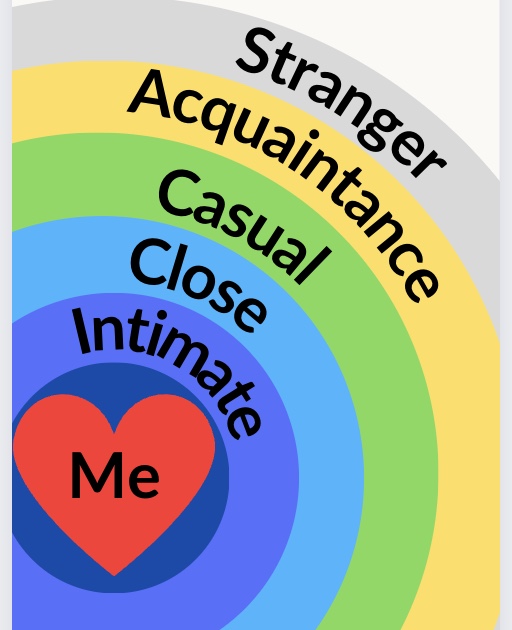
Understanding Human Connections: The Relationship Dartboard Model
You call your sister with big news. She’s scrolling while you talk. A flat “that’s great,” then a promise to call back that never comes.
The next day, a coworker you’ve known six months asks how it landed. She sets her phone face down. She asks a real follow-up question.
One of these people has the title. The other showed up.
We inherit expectations for the words we use. Family is supposed to feel like family. A friend is supposed to stay friendly. Nobody hands you the fine print, so you write your own version, then feel the sting when someone doesn’t follow a contract they never signed.
TIPP Skills: What Surviving a Bear Teaches You About Calming Down
A villager rounds a bend in the trail and locks eyes with a bear.
Nobody has to teach him what happens next. His body already knows.
That same wiring is still running the show today, whether the threat is an actual animal or a moment that’s tipped over into real crisis. TIPP is four tools built specifically for that tipping point. DBT calls this distress tolerance, the skill set for when an emotion has gotten too big to think your way through, and the body has to come down first before the mind can follow. Temperature. Intense Exercise. Paced Breathing. Progressive Muscle Relaxation. Four tools, and every one of them works the same direction, changing the mind by working on the body first.
Anxiety: A Complex Dance of Emotions and the Path to Overcoming It
Ever been startled by a stick looking eerily like a snake while hiking? That instantaneous surge of adrenaline, the pounding heart, and the irrepressible instinct to escape – that’s anxiety making its presence felt. It’s your body’s fight-or-flight reaction, every bit as real as the mistaken snake-like stick. Let’s dissect this intricate emotion and outline approaches to manage it.
You’re in good company. Though anxiety manifests differently for everyone, it’s a universally experienced sentiment. We tend to become overly gripped with anxiety, letting it color our identity and curb our life choices. Remember, anxiety doesn’t define you unless you permit it. It’s an emotion, not an intrinsic facet of your character.
Demystifying Anxiety: The Sympathetic Nervous System in Play
The Day My Military Life Began to Fade: A Soldier’s Battle with Mental Health
By the end of the day, the building was almost empty.
It had been twelve hours. Station after station. Line after line. The same annual screening every unit ran through that building, the way countless units had before us.
Everyone else had finished and gone home.
I sat alone in a side office with the lights mostly off. My hat was in my hands. I was crushing it without realizing I was doing it.
Embracing Honesty: Military Mental Health and the Unwritten Rule New Chapter Begins
Mental Health Awareness Month is upon us. But why? Why bother? You probably will not read this anyway. You will just keep doom scrolling.
I have never been much of a cheerleader. I do not get too excited about things. For a while I wondered if that was a shyness thing. Now I think it is something else. Battle-worn people, jaded if you want to call it that, tend to enjoy things with a side-eye of skepticism and find struggle oddly comforting. Hardship fits like a familiar pair of jeans.
So there will be no fanfare here. And no public trauma dump to fish for pity, or some fake, short-lived, emotion-driven interest in mental health. If you want my story, ask. This is just an extension of what I already do as a therapist. I hold up a mirror, so you, dear reader, might catch a glimpse of something that needs adjusting.
It is time to find a therapist. Most of us already keep a short list of people we trust. A primary care doctor. A good mechanic. A barber who knows what we want without being told. Therapy belongs on that list. Most people just have not added it yet.
We do our best with what we know. But there is no way to know what we do not know until someone shows us. When things start going sideways, it is a lot like the check engine light coming on. You can ignore it for a while. Eventually, something under the hood demands attention.
If feeling alone has been hard for you before, there is a good chance it is harder now.
We were not built to do life in isolation. And yet more of us are isolated than ever. In 2023, the U.S. Surgeon General called loneliness an epidemic, with health risks on par with smoking. About half of American adults report feeling it. So if you are carrying this, you are not strange, and you are not alone in it. You are part of a very large, very quiet crowd.
Alone Is Not the Same as Lonely
Being alone is a physical state. Loneliness is an emotional one.
You can be by yourself for a week and feel perfectly fine. You can also sit in a full room, at a party, in a marriage, and feel completely unseen. The two are not the same, and confusing them is part of what keeps people stuck. More people around you is not the cure. Being known is.
How Loneliness Feeds Itself
Here is the cruel part. The longer it goes on, the stronger it gets.
We start to over-identify with the feeling. It stops being something we are experiencing and starts becoming something we believe we are. From the inside it feels permanent, like a fact about us instead of a passing weather pattern. That belief is what turns a hard season into a cycle.
Making friends as an adult is genuinely difficult, and most of us were never taught how. It is hard to start a conversation. It is hard to find common ground. So we avoid the rooms where connection might happen, because we are afraid of feeling awkward or out of place. Every avoidance teaches the brain that reaching out is risky, and the feeling digs in deeper.
The Trap of Reaching for Anyone
When the ache gets loud enough, we get an urge to connect with someone. Anyone. Just to make it stop.
That urge is not your friend. Acting on it tends to make the feeling stronger, not weaker, and it leads to compromises we would never make on a steady day. We text the ex we know we should not. We download the app at midnight. We settle for company that leaves us lonelier than before.
It can also turn outward. Loneliness has a way of making us lash out at the very people we feel disconnected from, which pushes them further away and proves the story right. The feeling protects itself.
Breaking the Cycle
You break it the same way it formed. Slowly, on purpose, one small move at a time.
Start by letting go of the idea that things have to stay the way they are. Then get curious about adult friendship as an actual skill, one you can learn and get better at, the same as any other. There are new and creative ways to find your people, and a good place to begin is understanding how grown-up friendships actually form. This piece on making friends in adulthood is a solid first read.
And if the feeling has its hooks in deep, you do not have to climb out alone. That is what therapy is for. When you are ready, schedule an intake and we will get to work.
Ryan Sargent MSEd., LPCC
28 Feb, 2022
Cookie Consent
We use cookies to improve your experience on our site. By using our site, you consent to cookies.
Contains information related to marketing campaigns of the user. These are shared with Google AdWords / Google Ads when the Google Ads and Google Analytics accounts are linked together.
90 days
__utma
ID used to identify users and sessions
2 years after last activity
__utmt
Used to monitor number of Google Analytics server requests
10 minutes
__utmb
Used to distinguish new sessions and visits. This cookie is set when the GA.js javascript library is loaded and there is no existing __utmb cookie. The cookie is updated every time data is sent to the Google Analytics server.
30 minutes after last activity
__utmc
Used only with old Urchin versions of Google Analytics and not with GA.js. Was used to distinguish between new sessions and visits at the end of a session.
End of session (browser)
__utmz
Contains information about the traffic source or campaign that directed user to the website. The cookie is set when the GA.js javascript is loaded and updated when data is sent to the Google Anaytics server
6 months after last activity
__utmv
Contains custom information set by the web developer via the _setCustomVar method in Google Analytics. This cookie is updated every time new data is sent to the Google Analytics server.
2 years after last activity
__utmx
Used to determine whether a user is included in an A / B or Multivariate test.
18 months
_ga
ID used to identify users
2 years
_gali
Used by Google Analytics to determine which links on a page are being clicked
30 seconds
_ga_
ID used to identify users
2 years
_gid
ID used to identify users for 24 hours after last activity
24 hours
_gat
Used to monitor number of Google Analytics server requests when using Google Tag Manager
1 minute
You can find more information in our Cookie Policy and .