
You call your sister with big news. She’s scrolling while you talk. A flat “that’s great,” then a promise to call back that never comes.
The next day, a coworker you’ve known six months asks how it landed. She sets her phone face down. She asks a real follow-up question.
One of these people has the title. The other showed up.
We inherit expectations for the words we use. Family is supposed to feel like family. A friend is supposed to stay friendly. Nobody hands you the fine print, so you write your own version, then feel the sting when someone doesn’t follow a contract they never signed.
There’s a steadier way to sort this out. Not who’s supposed to be close to you. Who actually is.
There’s also a real ceiling on how many people can hold that kind of closeness at once, and it isn’t about effort. Anthropologist Robin Dunbar studied this and landed on a number: about 150. Not 150 people who’ll text you back. 150 you could place in a room and actually track how they relate to you and to each other. Your brain sets that limit. A thousand followers doesn’t change the math. You’ll still only really know a small circle of them.
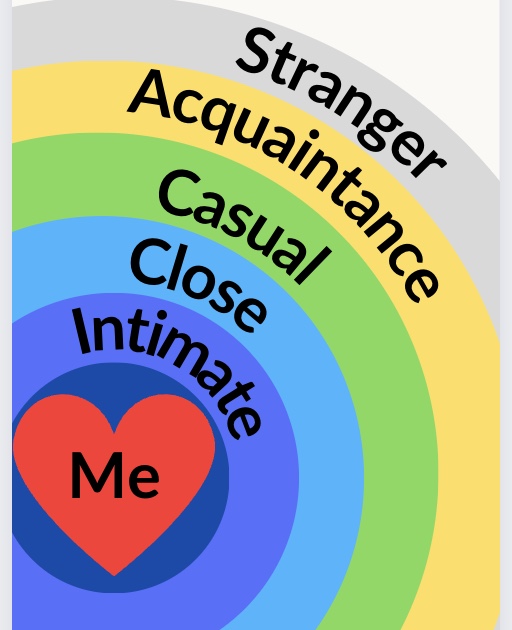
Picture a dartboard. Rings inside rings, moving out from the center. That’s the Relationship Dartboard Model: a way to stop sorting people by title, and start sorting them by what they actually do, how much time you’ve spent, and how many people share that ring with them.
Nobody’s permanently assigned to a ring, either. People move inward when trust deepens, outward when it doesn’t. And the clearest signal of which direction someone’s heading is how conflict gets handled between you. Handled well, a disagreement barely registers, sometimes it even pulls two people closer. Handled badly, again and again, it’s usually the real reason someone quietly ends up further out than their title would suggest.
The Center: You
“Only on a need-to-know basis.”
This ring holds one person. You. It’s where your unfiled thoughts live, the ones you haven’t handed to anyone yet. Your private habits, your unrehearsed fears, the version of a hard day you don’t perform for anyone else.
The conflict here isn’t with another person. It’s with yourself, when you skip the reflection and go straight to self-criticism, or when you’re so busy holding everyone else together that you stop noticing you need holding too. Self-compassion isn’t indulgence. Skip it here and it gets harder to offer anywhere else.
Intimate Friends
“I understand you.”
Not their favorite color. Their fears. A bond where the silence between two sentences carries as much as the sentences did.
One to five people live in this ring, built on 200-plus hours of the kind of time that actually changes two people. You’ve confided real things here. You’ve needed each other during something hard, and shown up.
Conflict costs the most in this ring, because there’s the most to lose. Say the true thing, even the uncomfortable version of it. Avoiding it, or softening it into something dishonest, is what actually pushes someone out to a further ring. Stay curious about what they’re feeling instead of only defending your side. Treat the relationship like something worth the effort of repairing, not something that holds together on its own. Neglect doesn’t end a friendship all at once. It just quietly turns an intimate friend into someone you used to be intimate with.
Close Friends
“I connect with you.”
The people who see you regularly enough to notice a shift in your week. Up to fifteen of them, on 100 to 200 hours of real time: the venting sessions, the standing plans, the birthdays you don’t forget.
When conflict shows up here, say what’s bothering you plainly. Sarcasm and the silent treatment both tend to do more damage than whatever started it. Disagreement is fine. Contempt isn’t. Ask what they think, and actually listen to the answer, or the friendship starts to feel one-directional.
Casual Friends
“I like you.”
Around fifty people, 50 to 100 hours in. The shared hobby, the group text that’s mostly memes, the person you’re always glad to run into.
Nothing here needs a deep excavation. A light conversation usually settles it, or letting it go does. Say plainly what you need if a line gets crossed. Dodge even that much, consistently, and the relationship tends to drift outward on its own. Not because anyone decided anything. Just because nobody did.
Acquaintances
“I know you.”
The coworker two teams over. The person from your gym class. Ten to fifty hours together, almost always inside one specific context.
A short clarification or a quick apology is usually the whole repair here. You’ll sidestep plenty of friction simply because you don’t see each other often enough for it to matter, and that’s fine. If something bigger does need sorting out, it usually happens through whoever you both already know, not through a direct conversation you don’t quite have the standing for yet.
Strangers
“I know of you.”
A face at the coffee shop. Someone you recognize but couldn’t tell you a real detail about. Zero to ten hours, and no real limit on how many people live here.
Most friction at this level barely registers. A nod, a quick word, and you both move on. If it escalates, you disengage. If it’s serious, you get help instead of handling it alone.
This is also where certain behavior belongs, no matter how close the person currently sits to your center. Manipulation. Constant blame-shifting. Belittling someone until they doubt what they saw with their own eyes. That behavior earns someone a move outward, all the way out, no matter what title they’ve been holding onto.
Shakespeare wrote a line for exactly this: “I do desire we may be better strangers.” Sometimes the healthiest thing you can do for a relationship is stop having one.
Not everyone gets the same access to you, and that isn’t coldness. It’s a boundary with a shape.
Watch what people actually do. The label was always just a guess. The behavior was the truth the whole time.